Gaudium pendant

The pendant, crafted in yellow gold, white gold, silver, and enameled bronze, is a combination of symbols and meanings that, in perfect harmony with one another, give the jewel a unique and unmistakable value.

Gaudium in Latin means joy; and what greater joy can a human being experience than that generated by the feeling that most inspires life — love.

The heart shape immediately evokes this feeling; the colorful plumage of a peacock represents its beauty, while the open little door in white gold at the center carries a double meaning:

Interpreted as the love between two people, one opens the door of their heart to the other and vice versa. Seen in a more spiritual light, it is God who opens the door of love to humankind, recalling the opening of the Holy Door in a Jubilee year as a gesture of welcome.

The dense part of the plumage, located at the bottom, resembles a small cobblestone path leading toward the open door.

The entire central section is surreally enclosed within a yellow-gold frame in the shape of an Ankh, the ancient Egyptian symbol of life, as if to remind us that love cannot exist without life, and that there is no life without a beating heart within it.

Love and joy are universal; they unite different cultures and religions…

JUBILEE PAPERWEIGHT

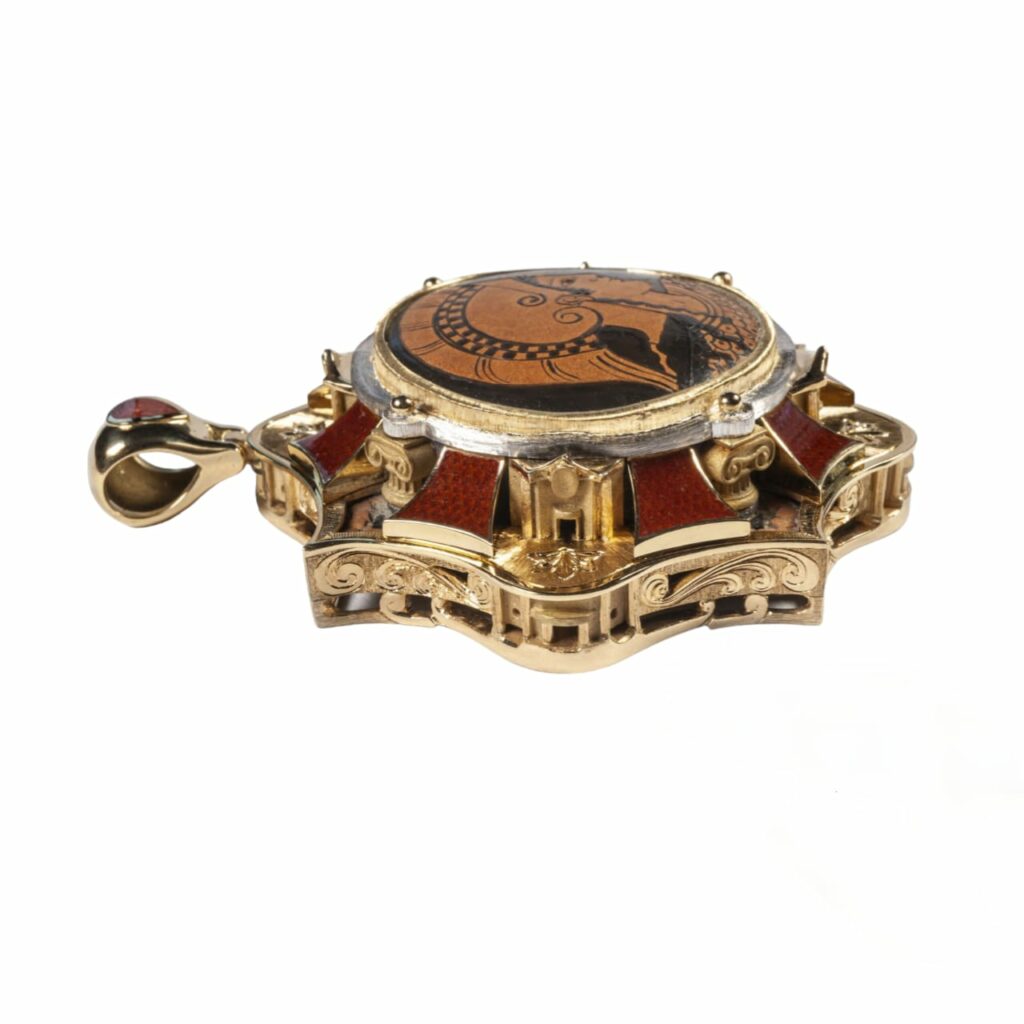
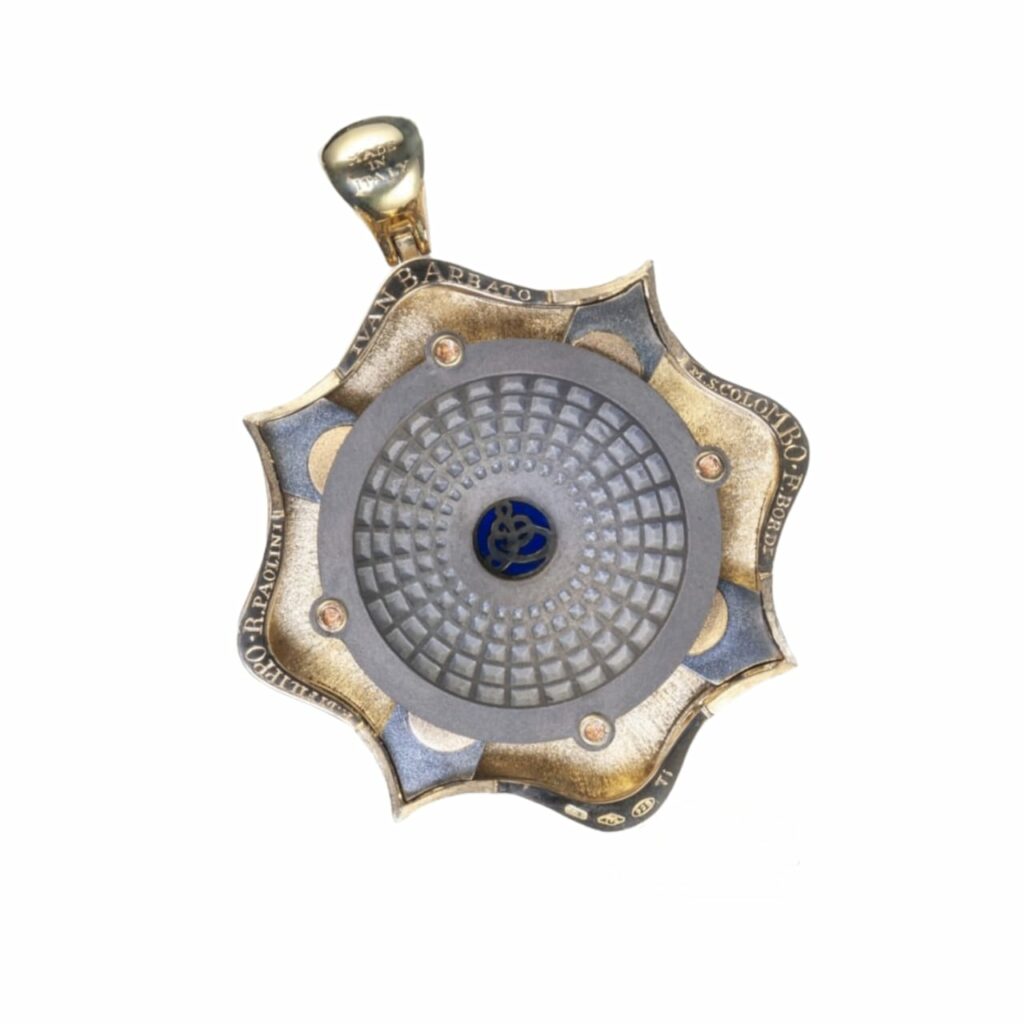
Made of precious metals, such as 750/1000 (18Kt) yellow gold and 925/1000 silver, resting on a sodalite base, the paperweight clearly evokes symbols and meanings associated with the Christian and Catholic religions.
The idea came from thinking about the first gesture that marks the beginning of the Jubilee Year, namely the opening of the Holy Door at St. Peter’s Basilica in Rome.


The central point of the desk ornament is in fact an open door, included in the famous colonnade of St. Peter’s Square, which directly contains the dome of the Basilica, albeit simplified and stylized compared to the real one.
The silver dome is a clear reference to the most important church in the world, on which a yellow gold cross, an unmistakable symbol of the Christian religion, rests delicately.

The cross is highlighted by the brightness of the precious metal and gradually slides down to the entrance of the colonnade, a passage that is one with the Holy Door, open and ready to welcome the faithful.

The meaning of the colonnade, as conceived by Bernini, namely the embrace extended to pilgrims arriving at the church, takes on even greater significance when directly connected to the door symbolizing the Holy Year, that special entrance leading to the house of God.


A beam of light radiates outwards from the central element of the scene, with golden and silver rays, a powerful light reminiscent of divine beauty.
The rays merge into a rainbow that encompasses the entire scene, a further symbol that for Christianity represents the covenant between God and man, a symbol of peace and hope…


The representation then evolves towards the lower part with a silver and gold parchment bearing the letters I H S, a monogram representing the name of Jesus which, when interpreted in Latin as ‘Iesus Hominum Salvator’, can also be understood as Jesus the savior of mankind.


The placement of the parchment parallel to the entrance of the passageway is as if to remind us that Jesus and God the Father are always ready to welcome man…

Luxury pendant: “Elements”

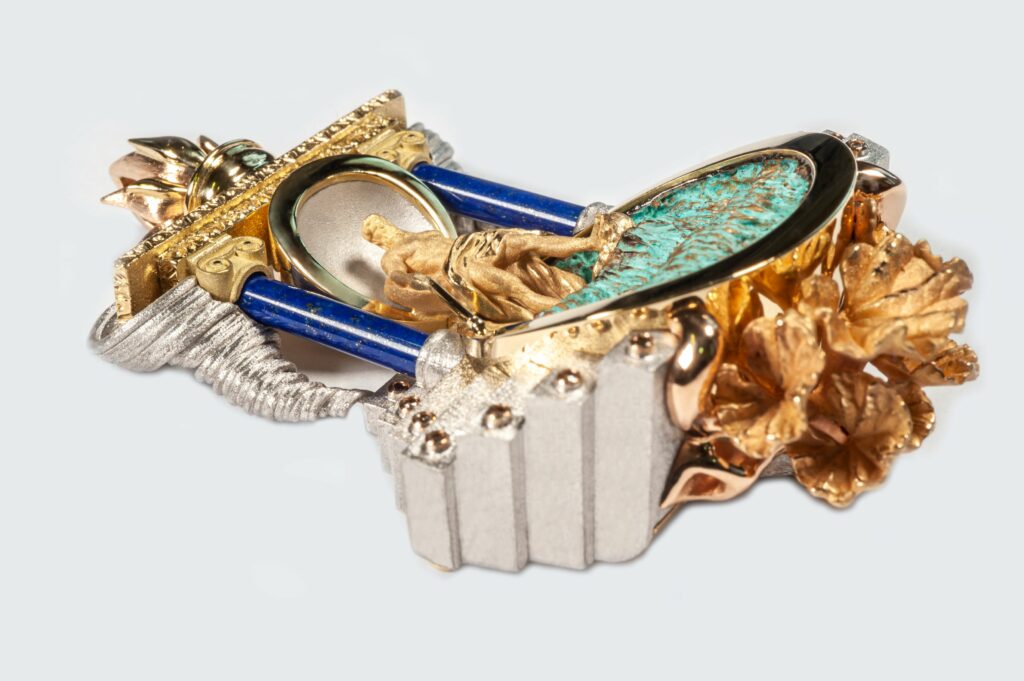
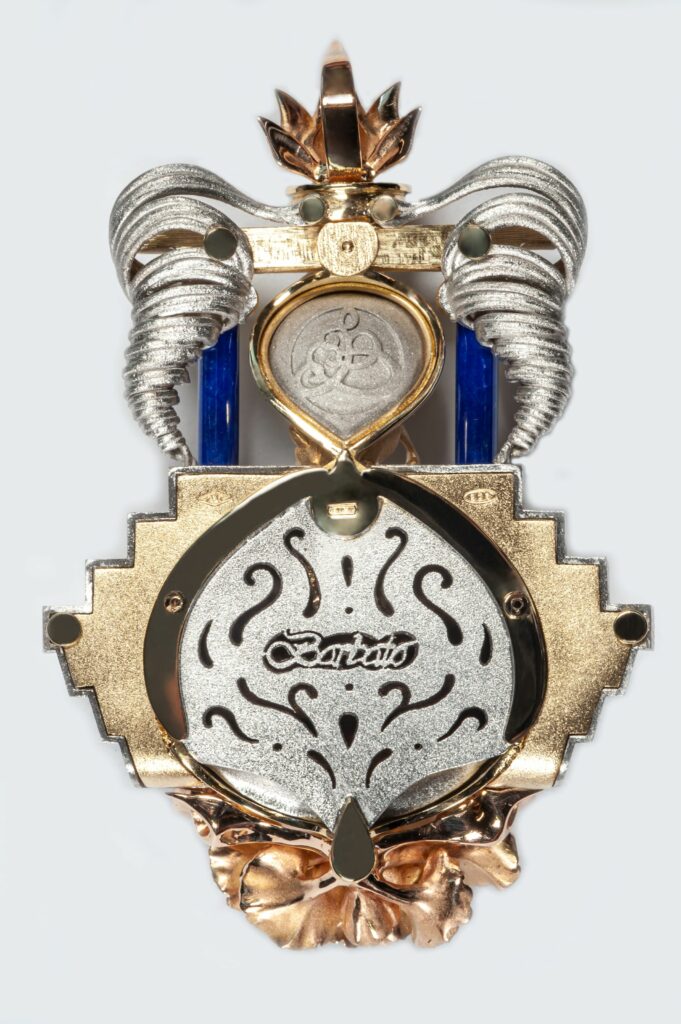
To represent its meaning, the jewel exploits the theatricality of the Baroque as a style rich in multiple details.

Clearly inspired by the famous Trevi fountain in Rome, at the center of the medallion there is the man who traces the infinite path of art, with another interpretation he can also be identified as God who guides the hand of man in this route.

However, man needs the four elements offered by nature to realize his works, so here is the representation of the fire placed high up, fed by the air generated by the vortices, then there is the water which falls through a waterfall towards the low by wetting the plants generated by the earth element, plants that produce the oxygen necessary for life.

The stairs placed at the sides, which recall another baroque work of the eternal city, namely the famous Spanish Steps in Trinità dei Monti, represent the route;

it is that of the man who creates the work of art by climbing professionally one step at a time, as happens in the stages of life itself…

TECHNICAL DATA SHEET:

Pendant in gold, silver, bronze and lapis lazuli

Gold g. 43.4

Silver g. 20.8

Bronze g. 9.8

UNIQUE PIECE

READY FOR DELIVERY

moving to the future

A balance between different themes translated into a unique jewel, second life, reuse, past and future meeting, tradition and modern technology.
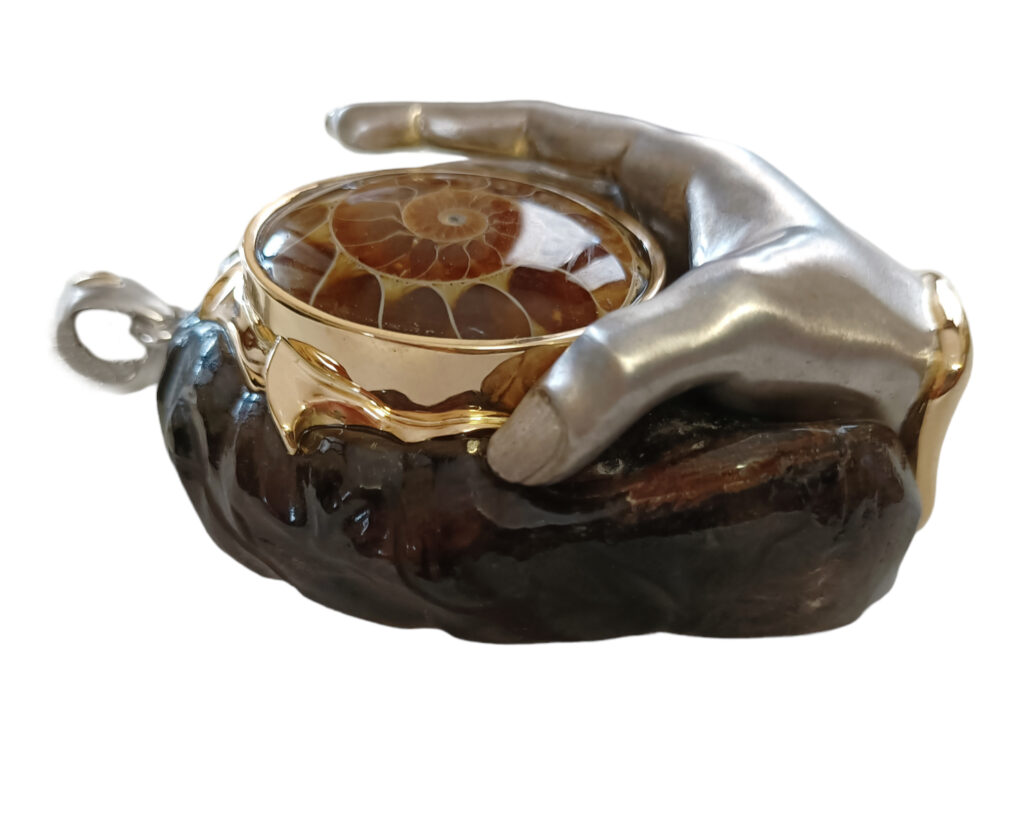
The idea was born precisely from wanting to combine a symbol of the future, identified by the hand, with something from the past.

The hand ideally represents the metaverse, while we observe virtually we have the perception of touching what we see.
The ammonite placed in the center of the pendant represents second life and reuse, a fossil of a prehistoric animal that finds new life in a jewel where matter, technique and symbols coexist in perfect harmony.

The ammonite almost seems to have the appearance of a clock that marks time, the passage…


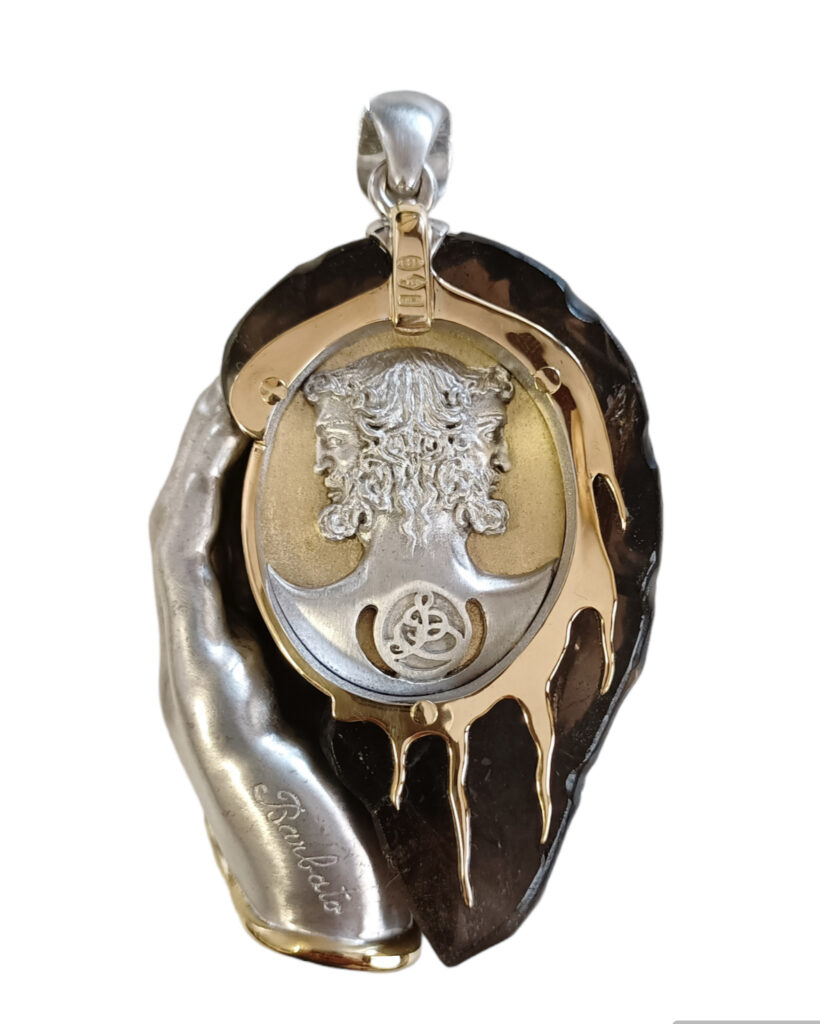
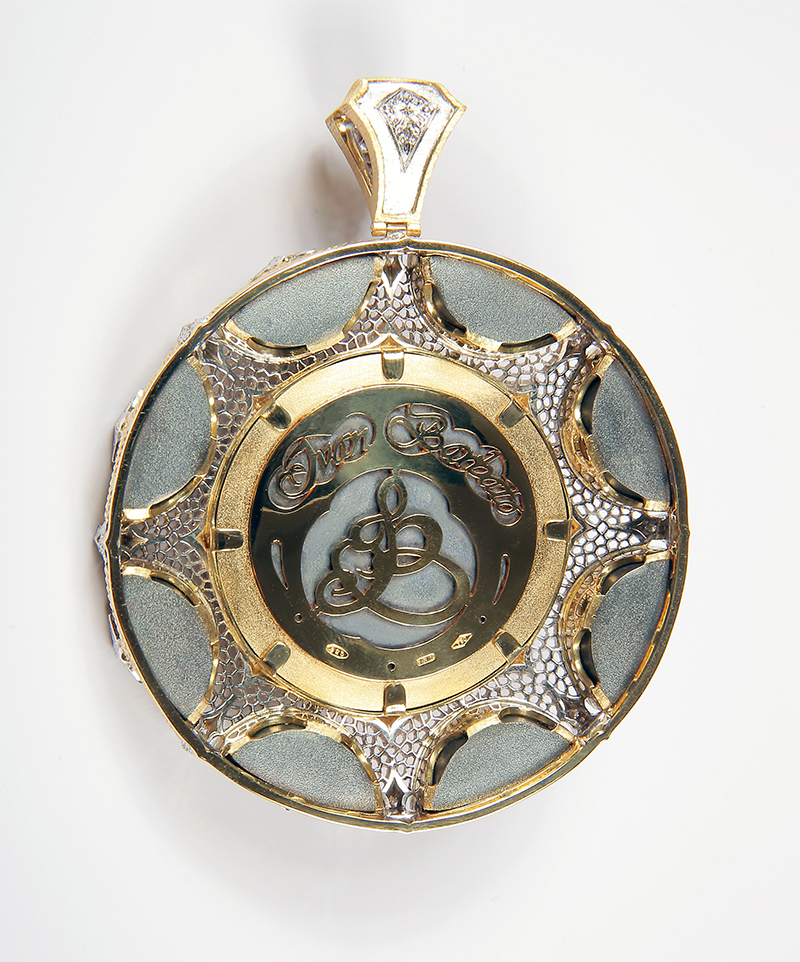
On the back of the pendant the ancient divinity of the Two-Faced Janus is represented, symbol of the passage and of every new beginning, with one face turned to the past and the other looking towards the future;

it seems to come out of a cave, from an archaic time, yellow gold veins superimposed on smoky quartz have the appearance of stalactites or rather of gold veins, just as precious material is born and then shaped by the hand of man.

UNIQUE PIECE

SOLD OUT

Luxury pendant:In the footsteps of time

Title of the jewel: “In the footsteps of time”

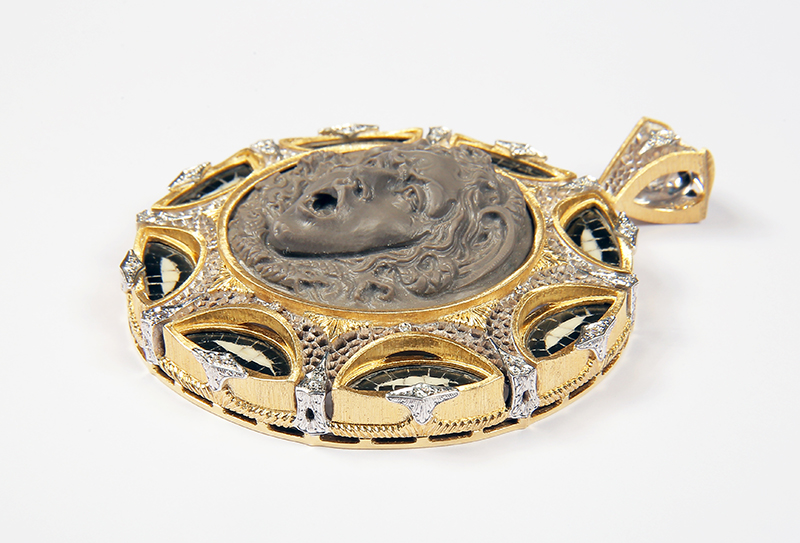
The jewel represents a journey through time, places and different forms of art;
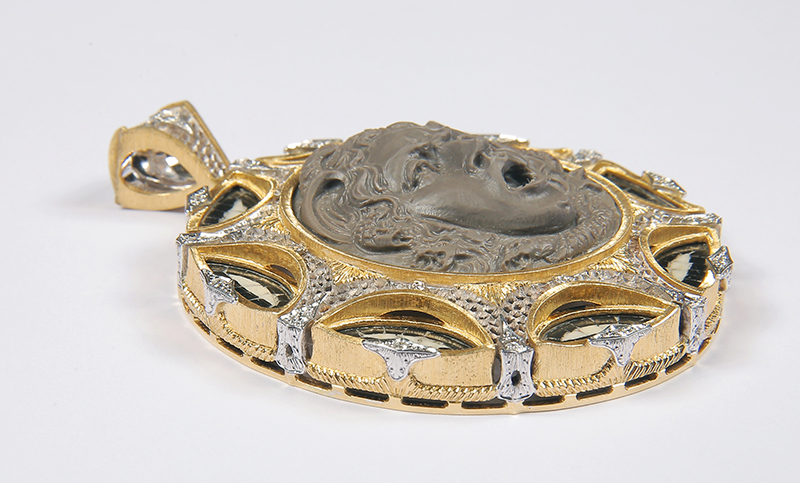
in a single piece coexists the goldsmith art of the Florentine Renaissance, the micro-mosaic in marble that recalls the ancient Roman floors and a mythological figure daughter of the ancient Greek civilization, cradle of Mediterranean culture.
It is a journey through the author’s own experience,
the face of Medusa recalls the themes of mythology appreciated since childhood, the material from which it was obtained is lava stone from Vesuvius and geographically leads to that Campania land to which he himself belongs through his origins, land of unique places in the world such as the ancient city of Pompeii, which through its excavations and its archaeological finds has always fascinated Ivan, hence the love for ancient Roman mosaics.
The journey then continues through the goldsmith’s art that unites everything, it is clear the reference to the Florentine techniques so much appreciated, learned and perfected in a training course that took place however far from the Tuscan capital but rather in the region where his atelier lives and is based. ; that territory between the lakes of Lombardy where Ivan has learned the work he loves and which he transmits through works like this one.